Understanding the “1 Full-Time Employee” Requirement
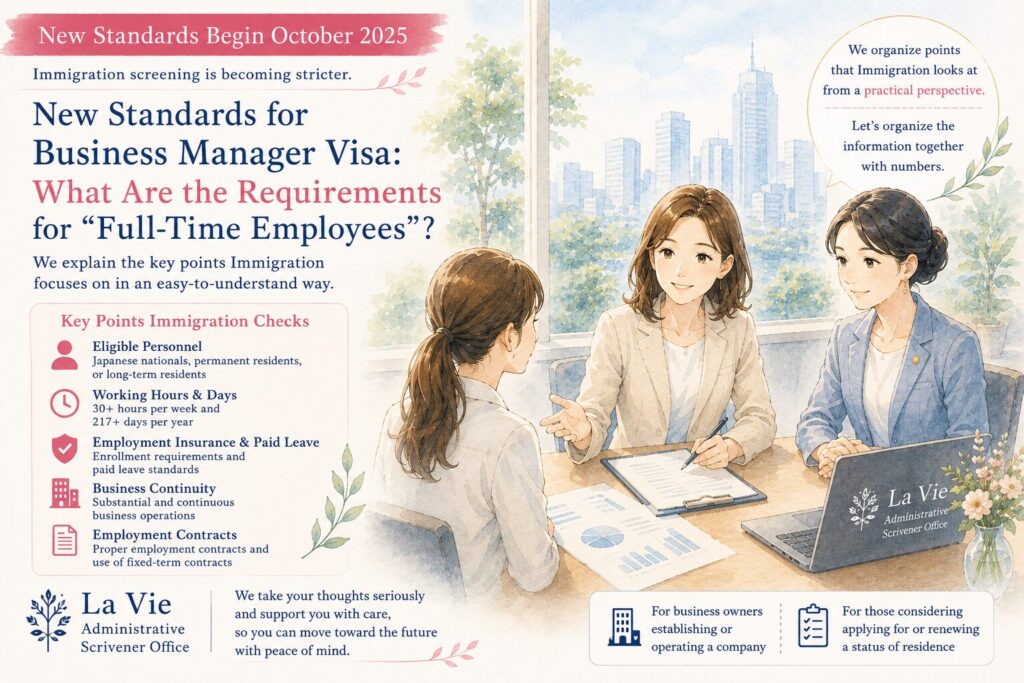
Recent amendments to Japan’s “Business Manager” (経営管理) visa regulations came into effect on October 16, 2025.
Much of the public discussion has focused on the increased capital requirement of JPY 30 million. However, from a practical perspective, many startups and small business owners are finding that another requirement may be even more challenging:
the mandatory employment of at least one full-time resident staff member.
For many foreign entrepreneurs, a common question is:
“How can I hire an employee before my own visa is even approved?”
This article explains the practical points behind the new requirement and how applicants may address it appropriately.
1. Who Qualifies as a “Full-Time Employee”?
Under the new standards, not every worker can be counted toward this requirement.
Generally, the employee must hold one of the following residence statuses:
- Japanese National
- Permanent Resident (永住者)
- Special Permanent Resident
- Spouse or Child of Japanese National / Permanent Resident
- Long-Term Resident (定住者)
Foreign nationals holding ordinary work visa statuses (such as Engineer/Specialist in Humanities/International Services) are generally not counted toward this requirement.
In addition, short-hour part-time workers are unlikely to satisfy the “full-time employee” criteria.
2. Immigration’s Definition of “Full-Time”
According to the Immigration Services Agency’s Q&A and practical guidelines, the employment conditions are reviewed carefully.
Important factors include:
- Working hours of at least 35 hours per week
- At least 217 working days per year
- Enrollment in Employment Insurance (雇用保険)
- Eligibility for statutory paid leave
Immigration authorities are expected to examine whether the employment arrangement reflects an actual and sustainable business structure, rather than a temporary or nominal arrangement.
As a result, “dummy employment” or purely symbolic staffing arrangements may create significant immigration risks.
3. Practical Issue: Hiring Before Visa Approval
In practice, one of the most difficult aspects of the new rule is timing.
Applicants are often required to secure a full-time employee before their own “Business Manager” visa has been approved. However, immigration processing may take many months depending on the case.
This creates a practical dilemma:
- the business owner cannot yet legally begin operations in Japan,
- while the company is still expected to demonstrate a concrete employment structure.
4. One Practical Approach: Employment Contracts with Conditions Precedent
To address this issue, some businesses utilize employment agreements with “conditions precedent” (停止条件付雇用契約).
Under this structure, the employment agreement becomes effective only after the applicant’s “Business Manager” visa is officially approved.
From a practical standpoint, this approach may help:
- reduce unnecessary financial risk before approval,
- demonstrate a genuine hiring intention,
- and present a more organized business structure to Immigration.
However, applicants should be careful not to allow employees to begin working before all necessary legal conditions are satisfied.
Conclusion
The 2025 amendments to Japan’s “Business Manager” visa system place greater emphasis on the substance and sustainability of business operations.
For many applicants, the real challenge may not simply be raising capital, but building a credible and compliant operational structure from the beginning.
Understanding the “full-time employee” requirement correctly — and preparing appropriate employment arrangements in advance — will become increasingly important under the new framework.
At La Vie Administrative Scrivener Office, we provide practical support for foreign entrepreneurs establishing businesses in Japan, including immigration strategy, compliance review, and business structure planning.